12 May 2025. 8 AM.
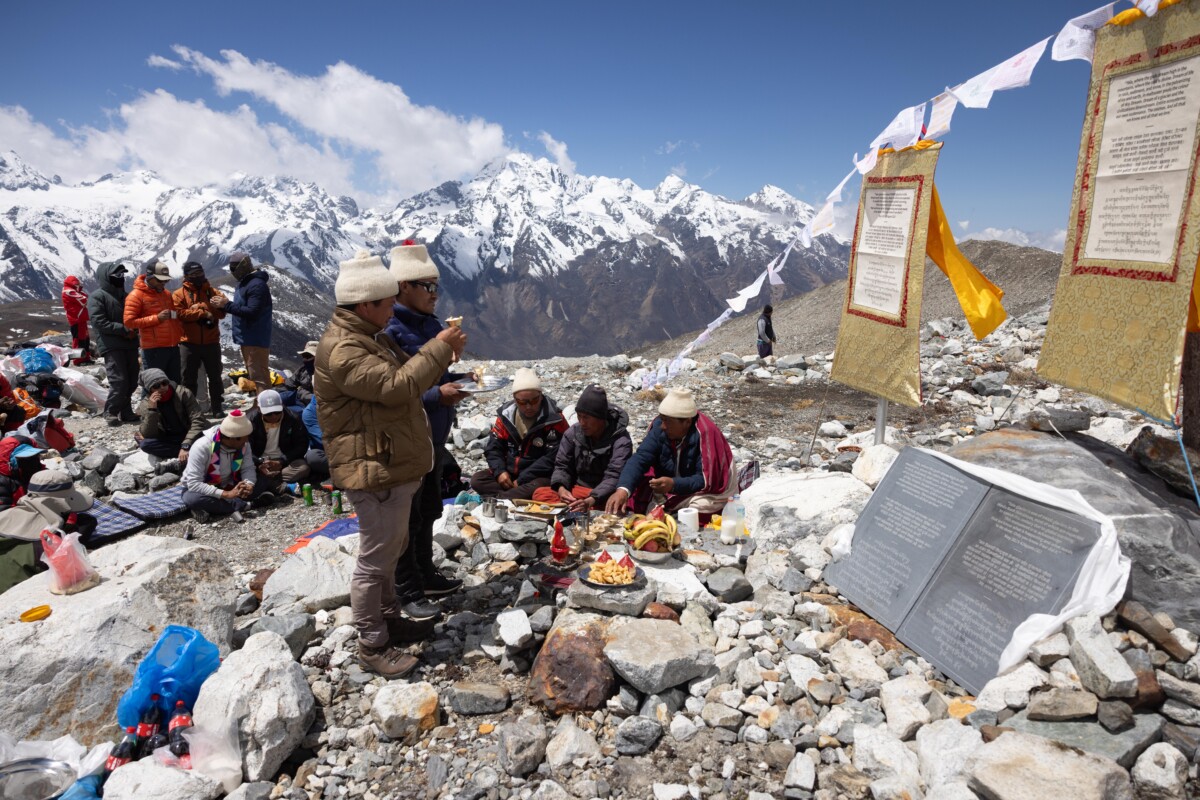
I refuse to call this an elegy. Prayer flags flutter in the mountain wind. A pair of ravens circle above the offering we have laid out. I lift my gimble, trying to capture the unfolding ceremony, but it can’t quite manage it. I feel what is happening inside my bones. The camera just cannot capture the atmosphere, the sacred energy of the moment.
 [1]
[1]The lhasang, a Buddhist purification offering is a Tibetan ritual that invokes deities. We are offering our lhasang to Yala Glacier and the peaks surrounding her – Khimshung, Dokphu, Tarna, Zokphu, Zangphu, Champu, and Serkori.
The glacier and its surrounding peaks are more than just geographical features. They are guardians, deities, and perennial sources of guidance and blessings for the communities of Langtang Valley. I look towards the glacier. I had climbed all the way to the ridge once, back in the spring of 2016. Today, standing here, it feels like I’m greeting an old friend.
In that moment, my responsibility to the glacier became clear to me – to I must sound the alarm, stir some sort of action to save it. I hesitate to say that the glacier is dying; rather I choose to believe we can revive it, naïve as this may sound.
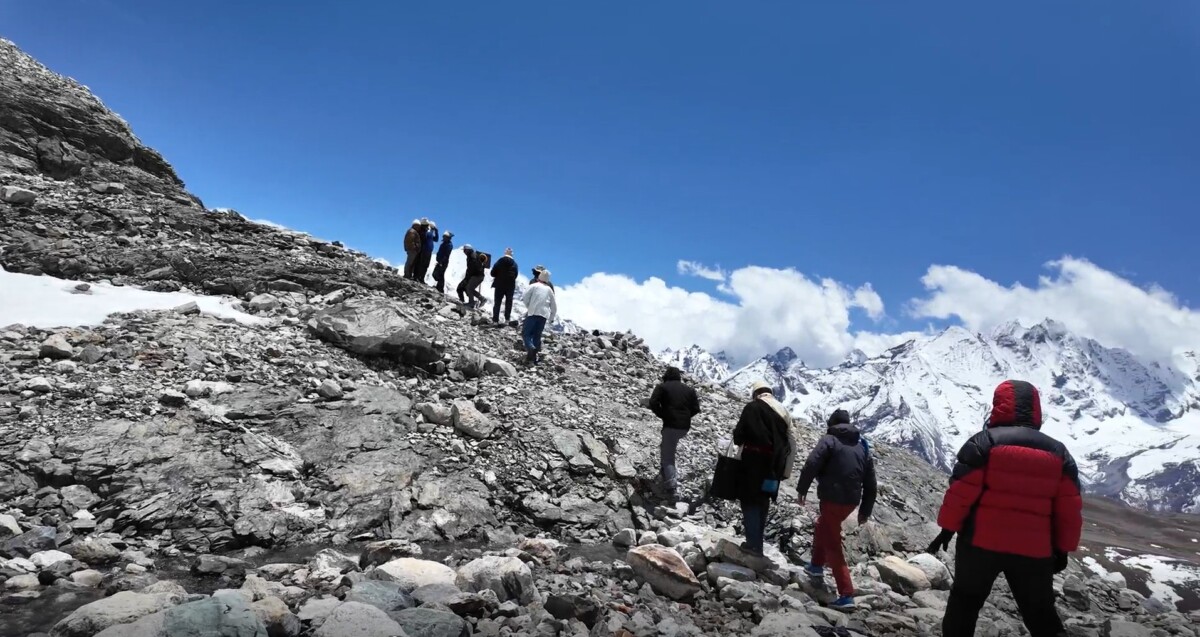
In 2016, I had stayed at the base camp for over a week, accompanying glaciologists from the International Centre for Integrated Mountain Development (ICIMOD) as they installed stakes and carried out a differential Global Positioning System (dGPS) survey of the glacier’s profile. Back then, I was recording the difficulties researchers faced when looking to understand the science of our frozen world. This time, I am here for a different story – that of the glacier itself.
“Argham, Padyam, Pushpe, Dhupe, Aloke, Ghende, Naividya, Shapda...”
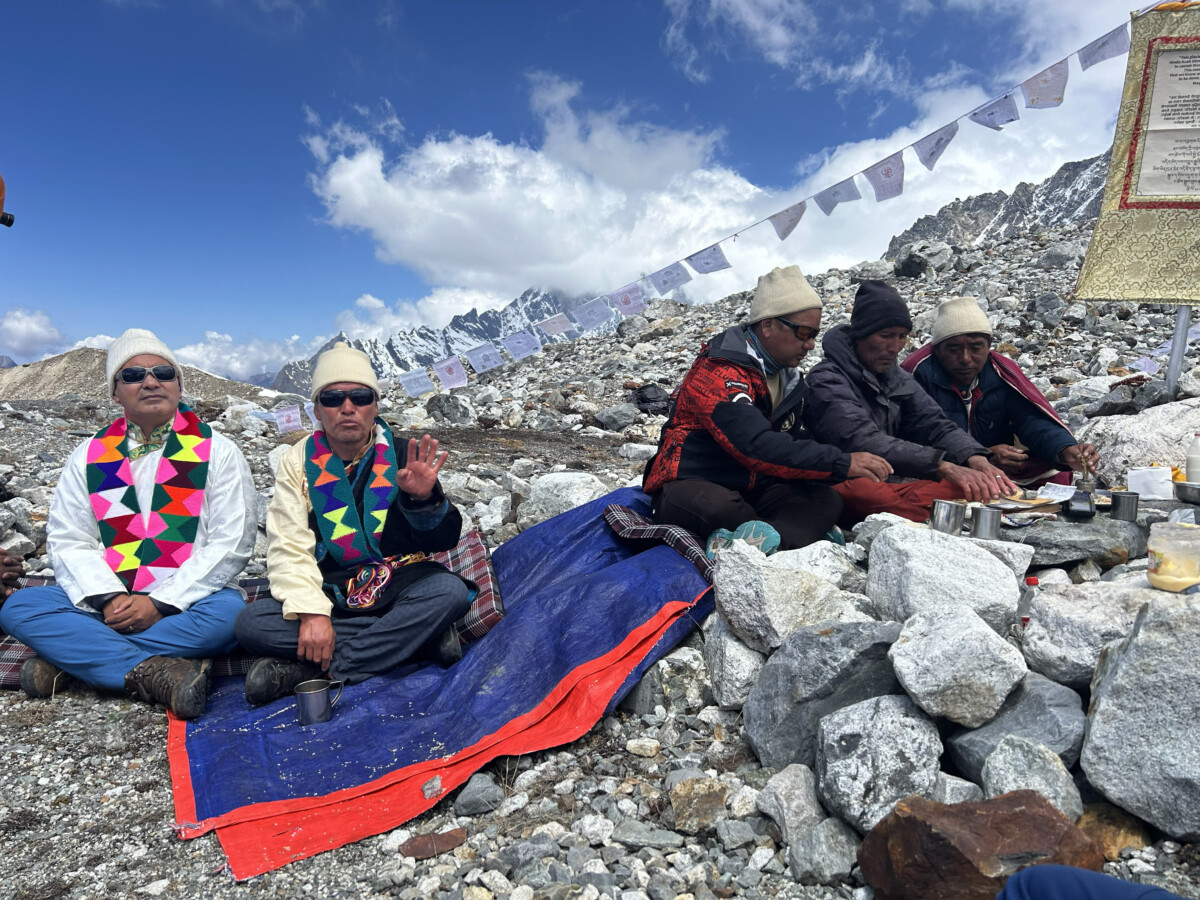
The monks’ chants pull me back to the present. Karma Lama Tamang, who was instrumental in organising this tribute, explains the ritual to me. “These are offerings to the gods we believe reside in the peaks surrounding Yala,” he says.
Offerings include water to drink (argham), water to bathe (padyam), flowers (pushpe), incense (dhupe), light (aloke), perfume (ghende), food (naivedya), and music (shapda). Each item is offered with care and devotion to honour the divine presence of these mountains.
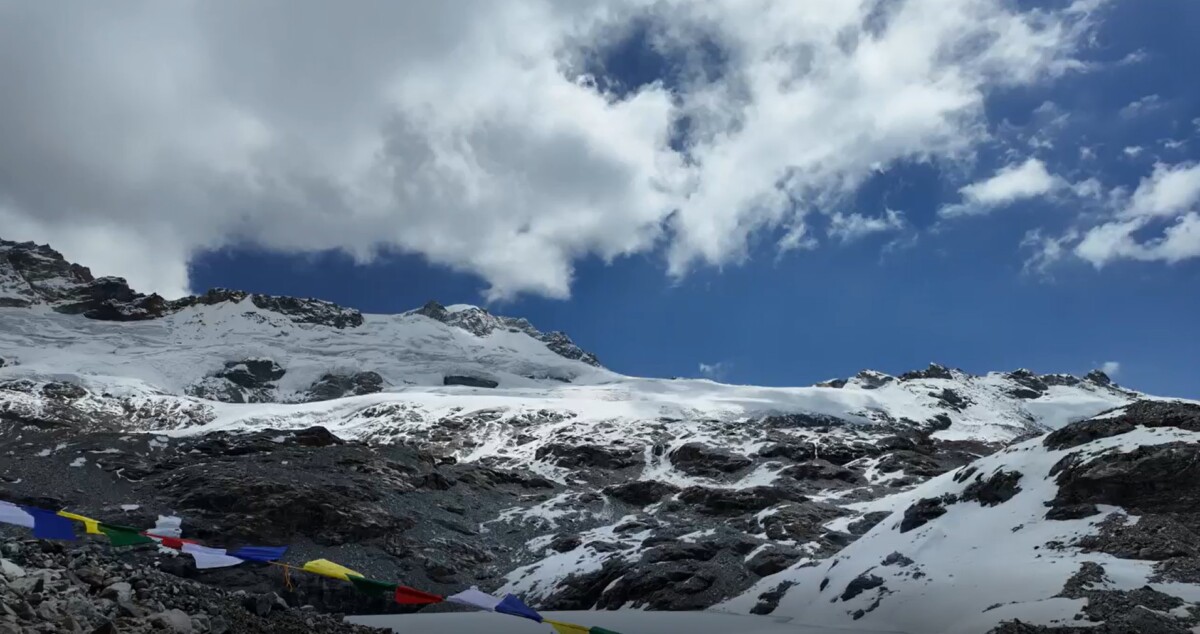
Just a decade ago, it would have been difficult to imagine such a solemn ritual to honour the glacier, to lament the loss of much of its ice. Yet the changes are undeniable. Yala Glacier is disappearing.
 [2]
[2]And yet, while it endures, a generation of scientists from the Hindu Kush Himalayan region have been trained by its measurements, monitoring, and movements; many of these scientists have gone on to shape regional and global climate discourse – from contributing as authors to the Intergovernmental Panel on Climate Change (IPCC) reports [3], to serving in international bodies, national agencies, and research institutions responsible for monitoring the frozen water towers.
In this part of the world, reverence for the natural world still runs deep. It is something I can feel just a few hours’ drive or walk from any major city in the region. The idea of honouring Yala Glacier flows as naturally as a mountain spring. It means recognising the role Yala played in shaping scientific inquiry and reminding ourselves of where we stand as glaciers continue to vanish while business proceeds as usual.
When our glaciers disappear, it strikes at the very core of who we are, a stark reminder that business as usual is no longer an option. Over the years, ICIMOD has led many conversations around the region’s cryosphere – through the HI-WISE Report (2023), building on the earlier Hindu Kush Himalaya Assessment (2019). Both assessments sound the alarm through facts and figures. The tribute to Yala offered a ground-level view of loss, reverence, and connection.
 [4]
[4]Yala Glacier holds deep meaning for communities in Langtang, Mundu and Kyanjin. It is the source of Yala tshaju menju. Tshaju means ‘salty water’ and menju means ‘medicinal water’. As Karma explained to me, the glacial river that melts from the snow seeps underground and emerges to form a pond.
"That pond once produced salt. People would collect the salt and trade it at a place called Tshongdue", says Karma. “The pond was said to have healing properties. Its waters could cure illness.”
The trade routes and customs Karma speaks about have faded. Communities have gradually shifted from yak herding and salt trading to tourism. Karma himself now runs a lodge, having released his yaks to roam the pastures, given the changing landscape and external demands.
 [5]
[5]“Chagg…tshelo! Chagtselo!” The crowd echoes as the two ritual helpers turn towards different directions of the mountains, bowing in reverence. This lhasang feels different from others I’ve experienced. It is deeper and more sacred. Imagine something so intimate and profound happening at over 5,000 metres above sea level (masl) – this was truly a once-in-a-lifetime experience. I am not from here, but I am from the mountains in the region. The lhasang is a poignant reminder of the powerful beauty of the shared, Indigenous culture of the mountains and people of the Hindu Kush Himalaya.
In Tibetan, which is a common language spoken in Langtang communities, lha refers to ‘deity’ and sang refers to ‘purification’. “Just as people bathe to cleanse themselves, deities too must be cleansed, especially when their surroundings are polluted by human wrongdoings,” Karma tells me. “When gods are defiled, misfortunes follow – illness, disasters, untimely weather, livestock deaths. Deities stop protecting when we stop being responsible to nature.”
In this lapsang, incense, purifying herbs and libation offerings are presented to Yala to cleanse and purify the deity. It is a gesture to acknowledge the offence humans have caused, to apologise and ask for forgiveness for what we have done and what we have failed to do. Yala’s main deity is believed to reside in Langtang Lirung – the highest peak of the Langtang region, standing at 7,234 masl. All the ridges and cliffs around it fall under its domain.
During the ritual, the main altar faces Langtang Lirung, and the names of all the surrounding ridges and cliffs are also recited. Each peak is honoured; each sacred forest and pond is named, remembered and revered.
As the last of the tsampa (buckwheat flour) is cast in deep reverence, a flock of ravens circles above. I watch the ceremony end; the ravens descend to feast on the offerings and the crowd disperses. I carry a quiet hope that we have done enough to cleanse and honour the Yala and the surrounding mountains. I pray that their blessings will continue.
Ravens hold a sacred presence in both Buddhist and Hindu traditions. They are seen as clever messengers between worlds. In Hindu belief, they link the living with ancestors and are worshipped on the first day of one of the most important festivals, Tihar. A Hindu myth tells of Bhusunda, a sage in crow form, who is witness to endless cycles of creation and dissolution, an eternal survivor and symbol of hope.
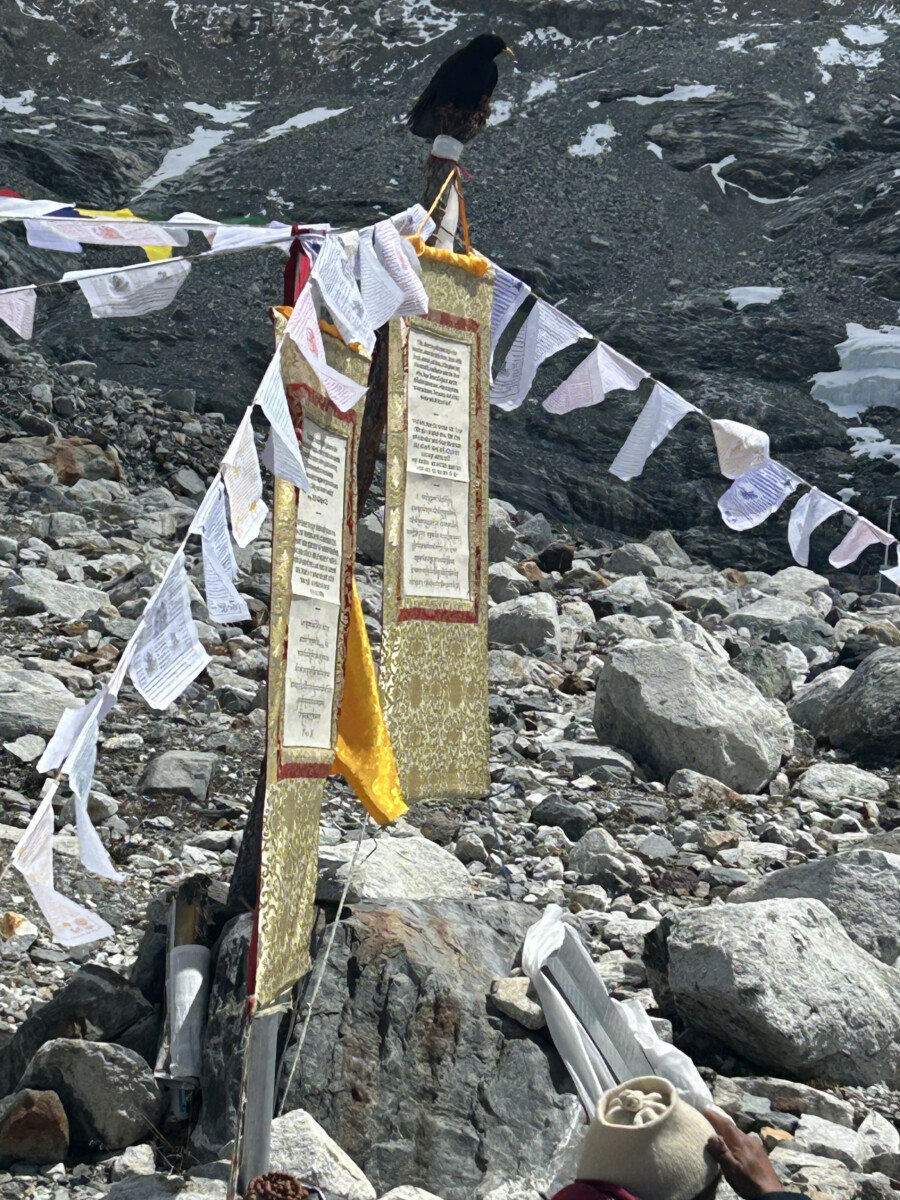 [6]
[6]I liken Yala to Bhusunda. With profound hope, I aspire to tell the story of the glacier that returns. With the same prayer, I pack my bags and prepare for the journey back to Kathmandu. As the team and I begin our descent of the valley, I carry Yala with me. The lhasang accompanies me throughout our journey back. Perhaps Yala is more resilient than we can imagine.
Acknowledgement: I would like to thank Arun Bhakta Shrestha, PhD for his guidance and inputs in bringing this blog to the shape.